
The Paris Agreement and Dangerous Tipping Elements
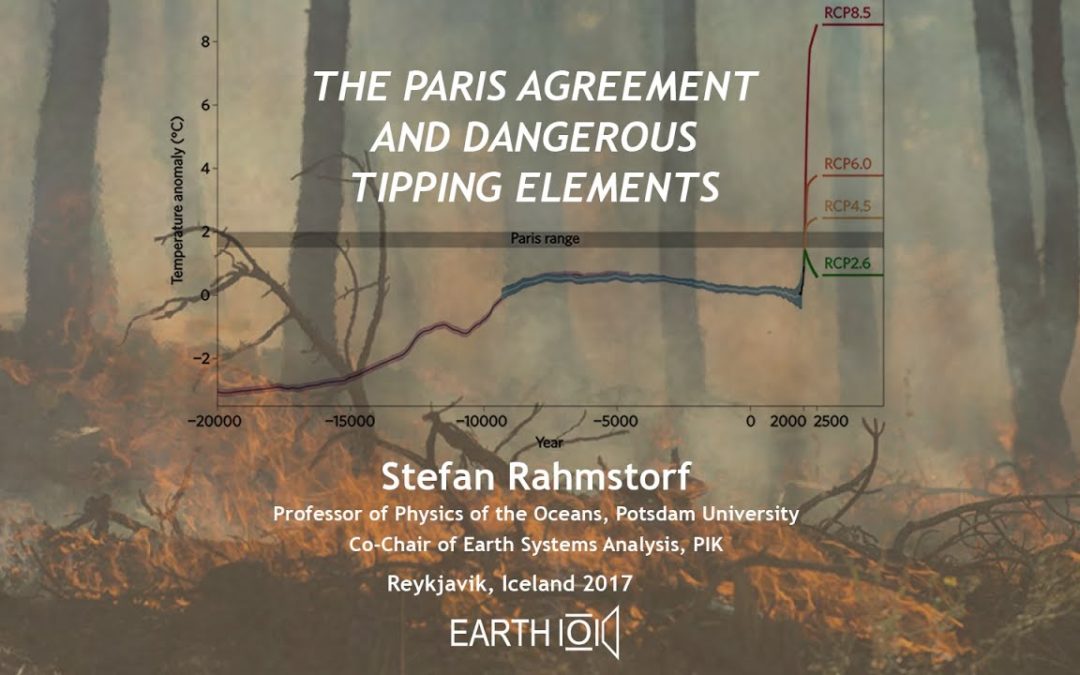
The Paris Agreement duly reflects the latest scientific understanding of systemic global warming risks. Limiting the anthropogenic temperature anomaly to 1.5–2 °C is possible, yet requires transformational change across the board of modernity. In this short Professor Stefan Rahmstorf talks about the premise behind the paper he wrote with Hans Joachim Schellnhuber and Ricarda Winkelmann in Nature Climate Change (Vol. 6, July 2016), “Why the right climate target was agreed in Paris”, in which they review the adequacy of the Paris target, looking at tipping elements in context of the global mean temperature evolution.
Stefan Rahmstorf obtained his PhD in oceanography at Victoria University of Wellington in 1990. He has worked as a scientist at the New Zealand Oceanographic Institute, at the Institute of Marine Science in Kiel and since 1996 at the Potsdam Institute for Climate Impact Research. His work focuses on the role of the oceans in climate change.


